

Artificial intelligence is rapidly transforming higher education. Universities around the world are experimenting with generative AI in classrooms, redesigning curricula, and racing to equip students with digital skills. Yet amid this technological acceleration, a more fundamental question is beginning to emerge.
Who should shape the future of AI?
For many, the answer lies not only with technology companies or governments, but increasingly with universities.
That question formed the basis of discussions at the 6th ASEF Higher Education Innovation Laboratory (ASEFInnoLab6), held in Košice, Slovakia, where academics, researchers, university leaders, and policy experts from Asia and Europe gathered to examine how higher education institutions (HEIs) can foster the responsible development and use of artificial intelligence. Rather than focusing solely on AI adoption, participants explored how universities can become enablers of AI that is inclusive, ethical, and centred on human values. Their reflections culminated in the Košice Manifesto, a set of ten principles intended to guide higher education institutions in navigating the AI era.
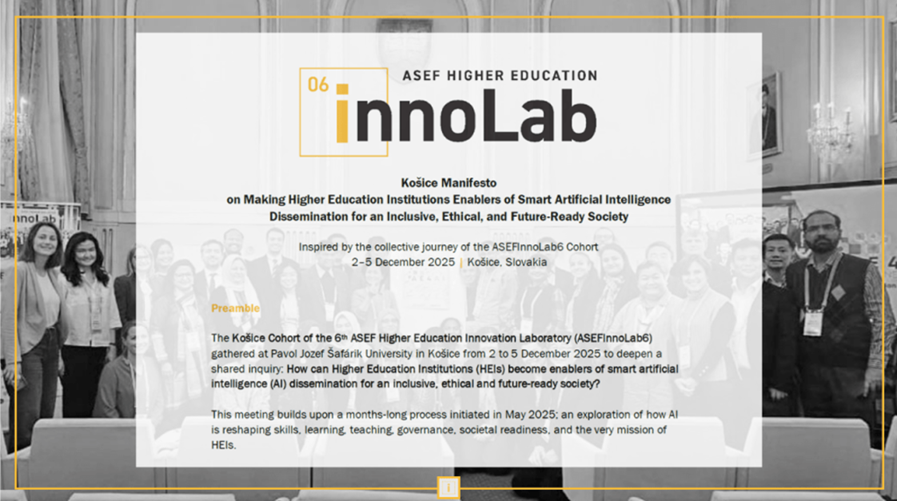
The manifesto arrives at a time when conversations about AI often revolve around competition: which countries will lead AI innovation, which universities will produce AI talent fastest, and which industries will benefit most from automation.
The Košice discussions offered a different perspective.
Rather than asking how universities can accelerate AI adoption, participants asked how universities can ensure that AI advances society rather than simply technology.
At the heart of the manifesto is a simple but powerful proposition: AI is not the story itself. Humanity’s capacity to use it wisely is.
That distinction fundamentally changes the role of higher education.
Instead of viewing AI literacy primarily as technical competence, the manifesto argues that AI readiness should begin with ethical judgement, critical thinking, inclusion, responsibility, and human dignity. Universities should not merely teach students how to use AI tools—they should cultivate graduates capable of questioning, governing, and improving those tools.
This represents an important shift in higher education policy.
For years, universities have responded to technological change by introducing new courses, updating curricula, and expanding digital skills programmes. Those efforts remain necessary, but they are no longer sufficient. AI is reshaping not only labour markets but also decision-making, public trust, creativity, and democratic participation. As a result, the challenge for universities extends beyond workforce preparation to safeguarding the values that underpin education itself.
One of the manifesto’s most striking recommendations concerns human cognitive autonomy.
In an era where AI can generate essays, code, and research summaries within seconds, participants cautioned against allowing convenience to replace independent thought. The manifesto encourages universities to preserve spaces for reflection, imagination, and original reasoning—even proposing practices such as allowing learners to develop ideas before turning to AI assistance.
The message is not to resist AI, but to ensure that technology continues to augment rather than replace human creativity and judgement.
The discussions also recognised that this transformation cannot rest solely on students.
Educators themselves require continuous support to navigate rapidly evolving technologies. Professional development, peer learning, and opportunities for experimentation were identified as essential if universities are to build confidence, strengthen ethical practice, and foster innovation without fear of failure.
Beyond teaching and learning, the manifesto reimagines universities as AI-enabled ecosystems.
Rather than acting in isolation, higher education institutions are encouraged to work alongside industry, governments, civil society, and local communities to co-create AI solutions that respond to real societal needs. This requires transparent governance, institution-wide standards, and collaboration across disciplines—not only within computer science, but also across law, education, business, health, and the humanities.
Perhaps most importantly, the Košice Manifesto reminds us that AI policy is ultimately about people.
The future of AI will not be determined solely by algorithms or computational power. It will also depend on the institutions that educate future leaders, establish ethical norms, and cultivate public trust.
Universities therefore face a broader mission than simply integrating AI into classrooms.
They are being called upon to shape how society understands, governs, and lives with AI.
For Southeast Asia and beyond, this message carries particular significance. As countries accelerate digital transformation and invest in AI capabilities, higher education institutions have an opportunity not only to produce AI talent, but also to ensure that technological progress remains grounded in inclusion, accountability, and the public good.

The Košice Manifesto does not claim to provide all the answers. Instead, it offers a starting point for a broader conversation—one that recognises universities not as passive adopters of technology, but as active architects of an AI future that remains fundamentally human.
Read the full Manifesto here
https://asef.org/wp-content/uploads/2026/02/260216_ASEFInnoLab6-Conference-in-Kosice_Manifesto.pdf
Disclaimer: Unless otherwise indicated, all third-party articles, images, publications, and materials featured on RIHED Policy Insights remain the property of their respective copyright holders. RIHED Policy Insights does not assert ownership over such content and provides attribution to the best extent possible for educational, research, and public information purposes.