
Universities have long measured success in familiar ways: graduation rates, employability statistics, research output, and global rankings. But as societies confront widening inequality, economic disruption, and questions of social cohesion, a larger question is beginning to emerge.
What if higher education is being asked to do more than produce graduates?
That question shaped the discussion during the webinar “Universities as Agents of Social Transformation and Nation-Building” organised through a partnership between the Southeast Asian Ministers of Education Organization Regional Centre for Higher Education and Development (SEAMEO RIHED), the Malaysian Academic Leadership Academy under the Ministry of Higher Education Malaysia (AKEPT) and the University of Kebangsaan Malaysia (UKM). Moderated by Prof. Dr. Sharifah Izzatwan Butteh and featuring insights from Prof. Dr. Syamsul Amri Bahadurudin, Prof. Dr. Mustafa Z. Yunis, and Assistant Professor Ilona Ophelia Bizanoria, the conversation explored a growing expectation placed on universities: to become institutions that not only educate, but also strengthen communities, expand opportunity, and shape more inclusive societies.
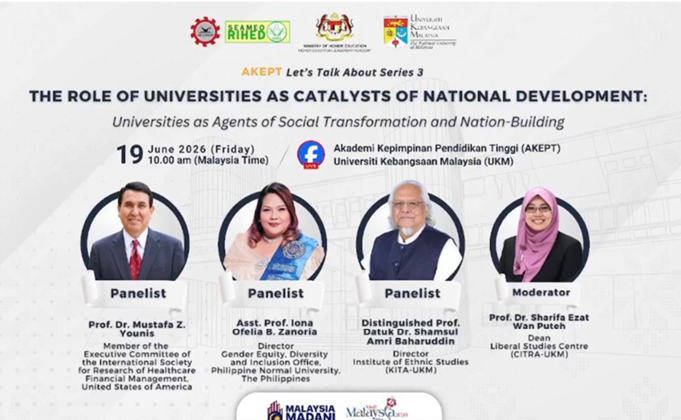
To maintain public trust and drive sustainable development, higher education must move away from rigid, market-driven metrics. Instead, universities must systematically incorporate community-engaged learning, equitable access, and socially accountable leadership.
The Shifting Paradigm of Higher Education
For decades, development strategies across Southeast Asia treated higher education expansion as an absolute public benefit. However, rapid expansion without clear differentiation among institutions has created systemic challenges across the region, including uneven graduate quality, overlapping programs, and rising underemployment.

As noted by the session moderator, Prof. Dr. Sharifa Ezat Wan Puteh (Dean of the Liberal Studies Centre at CITRA-UKM), this tension is deeply relevant following the launch of Malaysia’s Rancangan Pendidikan Tinggi Malaysia 2026–2035 (RPTM 2026–2035) which highlights how global forces reshape local classrooms. Universities are now caught between competing mandates: serving their historic role of character building and nation-building while simultaneously acting as drivers of global prestige and economic competitiveness.
The Shifting Paradigm of Higher Education
A university’s capacity to drive social transformation is restricted by how it is financed. When public funding is insufficient to meet expanding student demand, states frequently pivot toward commercialization, industry partnerships, and private provisions.

Prof. Dr. Mustafa Z. Yunis (Member of the Executive Committee of the International Society for Research of Healthcare Financial Management, USA) analysed these financial dynamics by contrasting global and domestic systems:
- The Western Fundraising Model:In highly commercialized systems like the United States, private higher education relies heavily on private donations, wealthy alumni networks, and massive cash reserves (endowments) that can exceed the economies of entire countries.
- The Cost of Inequality:Despite immense wealth, this model has seen a steady decline in social mobility since the 1980s. Skyrocketing tuition costs and reduced public programming have saddled graduates with extreme debt, turning higher education into a financial barrier rather than an equalizer.
- The Domestic Challenge:To systematically diagnose these divides within countries like Malaysia which experiences urban-rural and ethnic gaps, Prof. Dr. Yunis highlighted two analytical frameworks:
- The Vertical Nexus:Evaluating how deeply entrenched social classes and ethnic structures trap marginalized populations at the bottom of society.
- The Horizontal Nexus:Examining spatial and geographic divisions, specifically the resource and opportunity gaps separating urban, rural, and semi-urban populations.
To protect regional systems from these structural traps, the panel evaluated alternative frameworks such as the tuition-free public higher education models utilized in Germany and France as viable pathways to guarantee equitable access.
The Shifting Paradigm of Higher Education
True social transformation requires universities to move away from symbolic, top-down gestures and instead systematically embed community impact into their core operational structures.
Institutionalizing Community-Engaged Learning
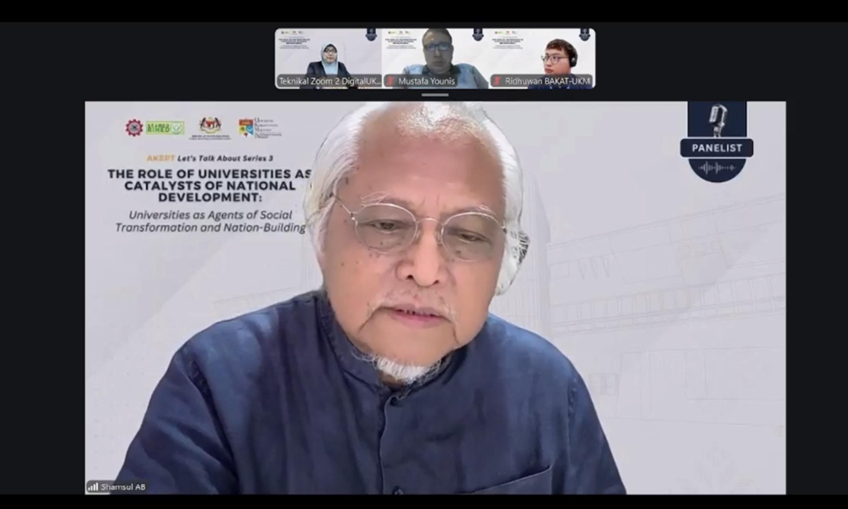
Distinguished Prof. Datuk Dr. Shamsul Amri Baharuddin (Director of the Institute of Ethnic Studies at KITA-UKM) emphasized that both public and private universities remain crucial engines for human capital development and upward social mobility. However, he argued that their responsibilities extend far beyond traditional classroom instruction. Academic roadmaps should mandate the integration of service-learning and participatory community projects into standard curricula. Rather than treating cultural preservation as an abstract academic exercise, universities must actively collaborate with local communities to include indigenous knowledge systems and regional histories. By applying theoretical knowledge to real-world social challenges, institutions foster critical civic engagement, transforming students into active participants in democratic life.
Institutionalizing Community-Engaged Learning
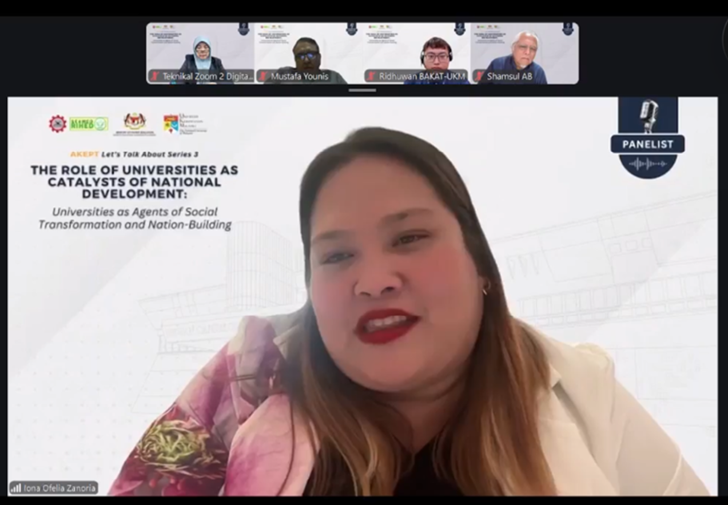
Sharing a practical institutional perspective from the Philippines, Asst. Prof. Iona Ofelia B. Zanoria (Director of the Gender Equity, Diversity and Inclusion Office at Philippine Normal University) explained that temporary diversity initiatives are insufficient to achieve long-term equity. Instead, universities must institutionalize robust, legally backed support mechanisms for special and marginalized populations:
- Contextualized Admissions:Moving away from rigid standardized academic metrics to evaluate applicants holistically, accounting for their socio-economic backgrounds, geographic constraints, and systemic barriers.
- Targeted Resource Allocation:Implementing fully funded, sustainable support structures such as institutionalizing zero-tuition pathways and providing professional sign-language interpreters for deaf learners with the explicit goal of empowering marginalized groups to step into leadership and educational roles within their own communities.
The Shifting Paradigm of Higher Education
As policymakers look toward 2035, the social relevance of higher education will depend entirely on reforming institutional governance and changing how success is measured.
Traditional metrics, heavily reliant on global research rankings, citation counts, and raw enrolment growth, frequently fail to correlate with meaningful societal contributions. The panel proposed a new matrix of accountability. Institutional success must be evaluated by the societal impact of an institution’s research and the holistic competency of its graduates. The primary indicator of a successful university should be its capacity to produce individuals who are not only technically and globally competent, but who are fundamentally humane, dedicated to justice, and respectful of their communities.
Achieving this shift requires a deliberate separation of university governance from political interference. To prevent unqualified political appointments in top institutional roles, selection frameworks should incorporate input from active alumni networks, local media, and community advocacy groups. Additionally, rigid human resource mandates such as fixed retirement ages should be re-evaluated to offer optional extensions, allowing institutions to retain highly experienced, socially committed academic leaders to guide the transition toward a more equitable higher education ecosystem.